Le rane di vetro addormentate si nascondono immagazzinando la maggior parte del loro sangue nel fegato / Sleeping glass frogs hide by storing most of their blood in their liver
Le rane di vetro addormentate si nascondono immagazzinando la maggior parte del loro sangue nel fegato / Sleeping glass frogs hide by storing most of their blood in their liver
Segnalato dal Dott. Giuseppe Cotellessa / Reported by Dr. Giuseppe Cotellessa
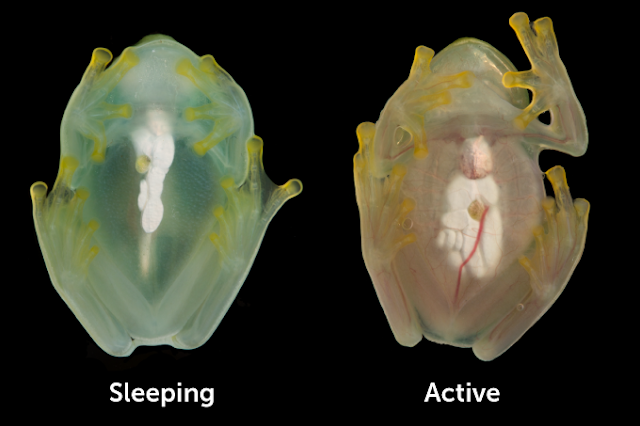
Quando una rana di vetro si sveglia ed inizia a muoversi, il sangue che aveva nascosto nel suo fegato durante il sonno riprende a circolare, diminuendo la trasparenza della minuscola rana. / When a glass frog wakes up and starts moving around, the blood that it had hidden in its liver while sleeping starts to circulate once more, decreasing the tiny frog’s transparency.
Gli animali aumentano la loro trasparenza impacchettando i globuli rossi senza effetti negativi.
Quando le minuscole rane di vetro si addormentano per la giornata, tolgono dalla circolazione quasi il 90 percento dei loro globuli rossi.
Le cellule colorate si stipano in tasche nascoste all'interno del fegato di rana, che nasconde le cellule dietro una superficie a specchio, trova un nuovo studio. I biologi hanno saputo che le rane di vetro hanno la pelle traslucida, ma nascondere temporaneamente il sangue rosso intenso porta una nuova svolta al camuffamento dei vertebrati ( SN: 23/06/17 ).
"Il cuore ha smesso di pompare rosso, che è il normale colore del sangue, e ha pompato solo un liquido bluastro", afferma il biochimico evoluzionista Carlos Taboada della Duke University, uno degli scopritori del sangue nascosto.
Ciò che può essere ancora più sorprendente per gli esseri umani - soggetti a fanghi circolari e ostruzioni - è che le rane tengono insieme quasi tutti i loro globuli rossi per ore senza coaguli di sangue, afferma il co-scopritore Jesse Delia, ora all'American Museum of Natural Storia a New York City. Sveglia la rana e le cellule si disimballano da sole e ricominciano a circolare.
Nascondere quei globuli rossi può raddoppiare o triplicare la trasparenza delle rane di vetro, Taboada, Delia e colleghi riferiscono su Science il 23 dicembre. Quella trasparenza verdastra può essere molto importante per le rane delle dimensioni di uno spuntino, che trascorrono la giornata nascondendosi come piccole ombre sul lato inferiore delle foglie in alto nella chioma della foresta.
Ciò che ha fatto riflettere Delia sulla trasparenza è stata un'emergenza fotografica. Aveva studiato il comportamento delle rane di vetro, ma non le aveva mai viste dormire. "Vanno a letto, vado a letto - quella è stata la mia vita per anni", dice. Quando aveva bisogno di alcuni ritratti carismatici, tuttavia, metteva alcune rane nei piatti del laboratorio ed alla fine vedeva come gli animali dormono tutto il giorno.
"Era davvero ovvio che non riuscivo a vedere alcun sangue rosso nel sistema circolatorio", dice Delia. "Ne ho girato un video: è stato pazzesco."
Mentre presentava il suo progetto ad un laboratorio della Duke University per il supporto, rimase sbalordito nello scoprire che un altro giovane ricercatore stava proponendo lo stesso laboratorio per studiare la trasparenza nelle rane di vetro. "Ero tipo, oh, amico", dice Delia. Ma il capo del laboratorio di ottica biologica alla Duke, Sönke Johnsen, ha detto a Delia ed al suo rivale, Taboada, che avevano competenze diverse e che avrebbero dovuto affrontare il problema insieme. "Penso che all'inizio fossimo testardi", dice Delia. "Ora lo considero vicino come una famiglia."
Mostrare cosa fanno i globuli rossi nelle rane viventi ha creato un puzzle difficile. La microscopia ottica non funzionerebbe per vedere attraverso il tessuto esterno simile ad uno specchio del fegato. Né farebbe nulla che svegliasse le rane ( Hyalinobatrachium fleischmanni ), perché i globuli rossi si precipiterebbero attraverso il corpo. Anche anestetizzare le rane ha impedito al trucco del fegato di funzionare.
La risposta trovata da Delia e Taboada proviene da una tecnica chiamata imaging fotoacustico, utilizzata principalmente dagli ingegneri. Rivela interni nascosti grazie alle sottili vibrazioni create dalla luce che colpisce varie molecole e provoca lievi rilasci di energia. Junjie Yao di Duke si è unito al gruppo glass frog per adattare la tecnica ai fegati di rana, prestando particolare attenzione a non svegliare gli animali durante il processo.
Nonostante il nome delle rane di vetro, la trasparenza tra i vertebrati può diventare molto più estrema, afferma la biologa ittica Sarah Friedman dell'Alaska Fisheries Science Center della National Oceanic and Atmospheric Administration a Seattle. A giugno ha twittato un'immagine di un pesce lumaca macchiato appena catturato ( Crystallichthys cyclospilus ), abbastanza chiaro nella maggior parte del suo corpo da mostrare i toni della carne e le linee delle dita nella sua mano mentre lo cullava. E questo non è nemmeno l'esempio migliore. Gli stadi larvali di pesci tarpon e anguille, pesci vetro e una specie di pesce gatto di vetro asiatico "sono quasi perfettamente trasparenti", afferma Friedman, che non è stato coinvolto nel nuovo studio.
Ma queste meraviglie hanno il vantaggio di vivere nell'acqua, dice. L'evoluzione della squisita vetrosità è più facile dove non c'è una differenza visibile così netta tra i corpi degli animali e le loro case acquose. Tuttavia, avere un corpo trasparente è piuttosto bello, a terra od in mare.
ENGLISH
The animals up their transparency by packing away red blood cells with no ill effects
As tiny glass frogs fall asleep for the day, they take almost 90 percent of their red blood cells out of circulation.
The colorful cells cram into hideaway pockets inside the frog liver, which disguises the cells behind a mirrorlike surface, a new study finds. Biologists have known that glass frogs have translucent skin, but temporarily hiding bold red blood brings a new twist to vertebrate camouflage (SN: 6/23/17).
“The heart stopped pumping red, which is the normal color of blood, and only pumped a bluish liquid,” says evolutionary biochemist Carlos Taboada of Duke University, one of the discoverers of the hidden blood.
What may be even more amazing to humans — prone to circulatory sludge and clogs — is that the frogs hold almost all their red blood cells packed together for hours with no blood clots, says co-discoverer Jesse Delia, now at the American Museum of Natural History in New York City. Wake the frog up, and cells just unpack themselves and get circulating again.
Hiding those red blood cells can double or triple the transparency of glass frogs, Taboada, Delia and colleagues report in the Dec. 23 Science. That greenish transparency can matter a lot for the snack-sized frogs, which spend the day hiding like little shadows on the undersides of the leaves high in the forest canopy.
What got Delia wondering about transparency was a photo emergency. He had studied glass frog behavior, but had never even seen them asleep. “They go to bed, I go to bed — that was my life for years,” he says. When he needed some charismatic portraits, however, he put some frogs in lab dishes and at last saw how the animals sleep the day away.
“It was really obvious that I couldn’t see any red blood in the circulatory system,” Delia says. “I shot a video of it — it was crazy.”
As he pitched his project to a Duke University lab for support, he was stunned to discover that another young researcher was pitching the same lab to study transparency in glass frogs. “I was like, oh, man,” Delia says. But the leader of the biological optics lab at Duke, Sönke Johnsen, told Delia and his rival, Taboada, that they had different skill sets and should tackle the problem together. “I think we were hardheaded at first,” Delia says. “Now I consider him as close as family.”
To show what red blood cells do in living frogs made a tough puzzle. Light microscopy wouldn’t work for seeing through the mirrorlike outer tissue of the liver. Nor would anything that woke up the frogs (Hyalinobatrachium fleischmanni), because the red blood cells would rush out through the body. Even anesthetizing the frogs kept the liver trick from working.
The answer Delia and Taboada found comes from a technique called photoacoustic imaging, mostly used by engineers. It reveals hidden interiors thanks to the subtle vibrations created by light striking various molecules and causing slight energy releases. Duke’s Junjie Yao joined team glass frog to tailor the technique to frog livers, taking special care not to wake the animals in the process.
Despite glass frogs’ name, transparency among vertebrates can get much more extreme, says fish biologist Sarah Friedman of the National Oceanic and Atmospheric Administration’s Alaska Fisheries Science Center in Seattle. She tweeted an image in June of a newly caught blotched snailfish (Crystallichthys cyclospilus), clear enough in most of its body to show flesh tones and finger lines in her hand as she cradled it. And that’s not even the best example. The larval stages of tarpon fish and eels, glassfishes and a kind of Asian glass catfish “are almost perfectly transparent,” says Friedman, who wasn’t involved in the new study.
But these marvels have the advantage of living in water, she says. Evolving exquisite glassiness is easier where there’s not as sharp a visible difference between animals’ bodies and their watery homes. Still, having a transparent body is pretty cool, on land or sea.
Da:
https://www.sciencenews.org/article/sleeping-glass-frogs-blood-liver?utm_source=email&utm_medium=email&utm_campaign=latest-newsletter-v2&utm_source=Latest_Headlines&utm_medium=email&utm_campaign=Latest_Headlines


Commenti
Posta un commento